News
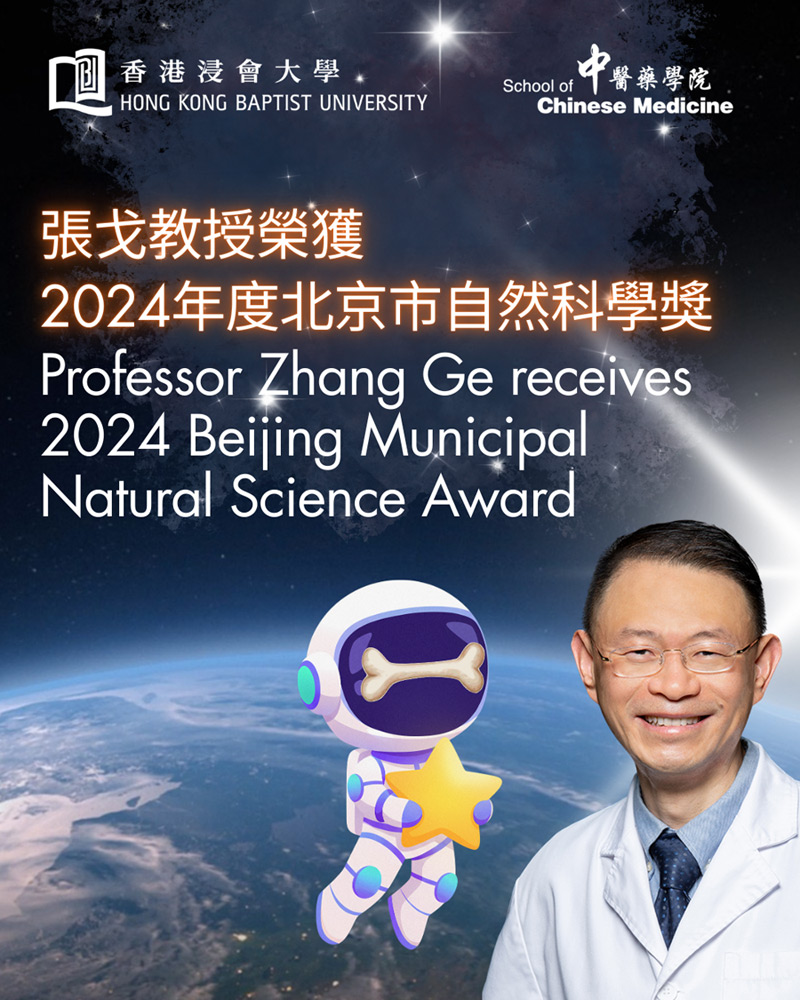
Transdisciplinary collaboration: Professor Zhang Ge receives 2024 Beijing Municipal Natural Science Award
5 February 2026
Professor Zhang Ge, Associate Dean (Research) and Chair Professor of the School of Chinese Medicine, and his joint research team from Tsinghua University, Peking University, and China Astronaut Research and Training Center, received the Second Class Award of the 2024 Beijing Municipal Natural Science Award for their project “Multi‑level Regulatory Mechanisms of Weightlessness‑induced Bone Loss”.
Addressing the challenges posed by extreme space environments, the project investigated the mechanisms by which prolonged weightlessness leads to bone loss in astronauts. The research team discovered that the Piezo1 mechanosensitive ion channel, located in cell membranes, plays a crucial role in gravity sensing. They also introduced a novel model showing how calcium microdomains help regulate bone metabolism. Notably, this research pioneered the discovery of the key regulatory mechanisms behind weightlessness‑induced bone loss from the perspective of non‑coding RNAs, further clarifying the role of exosome in regulating bone tissue homeostasis. To manage these conditions and osteoporosis, the team also developed precise monitoring and therapeutic strategies targeting small RNAs and exosomes. Building on these advances, the study not only opens up new avenues for researching and combating bone loss caused by spaceflight, but also sheds light on bone health challenges linked to prolonged bed rest and age‑related osteoporosis.
The Beijing Municipal Natural Science Award, a distinguished recognition in the Chinese scientific community, is conferred by the People’s Government of Beijing Municipality. The award presented to Professor Zhang and the joint team highlights the outstanding achievements arising from the School’s transdisciplinary collaborations with leading research institutions in the Chinese Mainland. Moving forward, the School will continue to deepen its partnerships with international organisations, and is poised to achieve many more research breakthroughs.